How AI Automation Is Reducing Business Operational Costs
Businesses today are constantly looking for ways to reduce operational costs, improve productivity, and achieve better results with limited resources. Managing daily operations manually can consume significant time, increase expenses, and create unnecessary challenges. This is where AI automation is making a difference. By combining artificial intelligence with automated workflows, businesses can simplify repetitive tasks, improve efficiency, and manage their operations more effectively.
At SPRWORK Infosolutions, we help businesses explore modern technology solutions, AI integration, and digital services that support business growth. With the right AI-powered tools and automation strategies, companies can reduce manual workloads and focus more on important business activities.
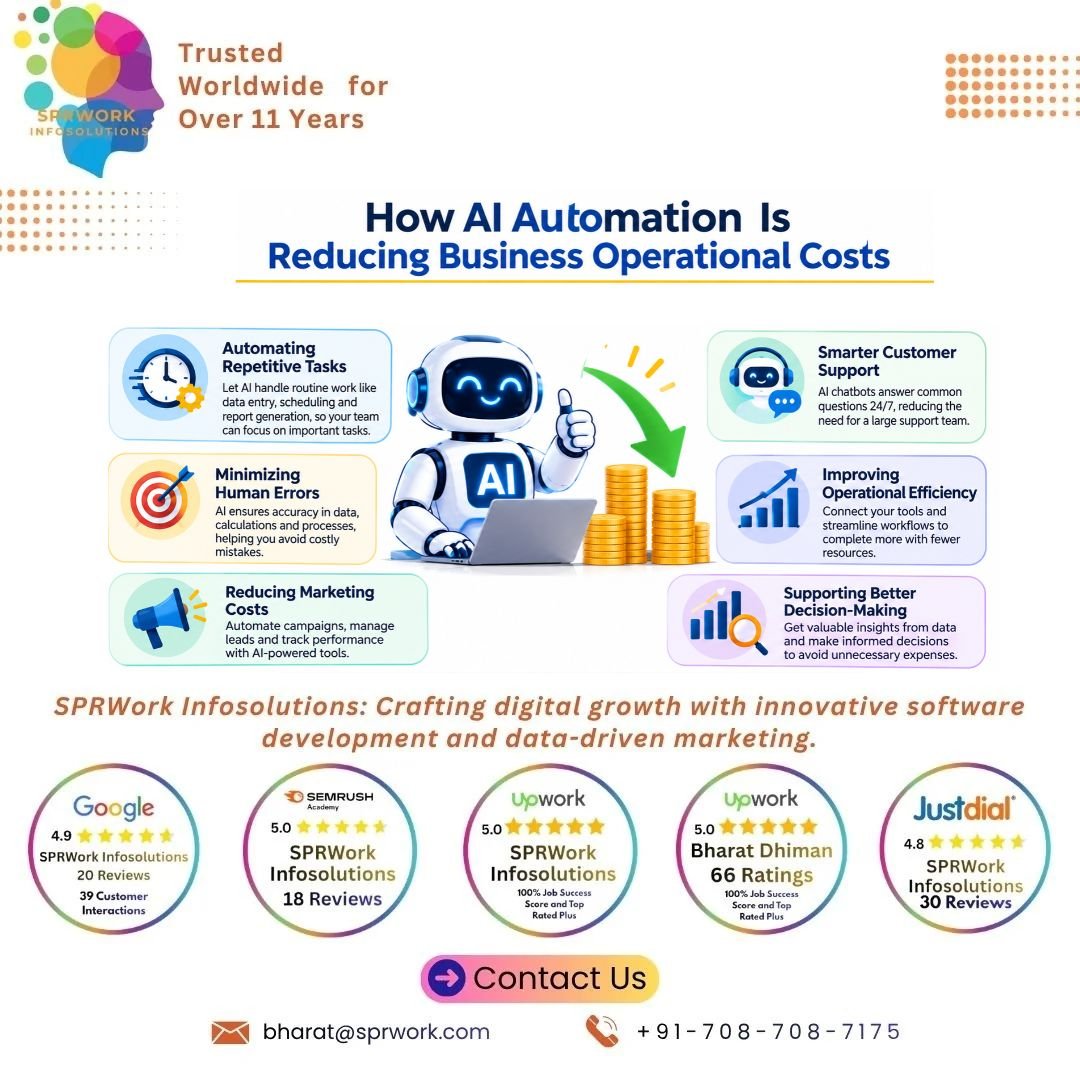
1. Reducing Manual Work and Repetitive Tasks
One of the biggest advantages of AI automation is its ability to handle repetitive tasks that traditionally require human involvement. Activities such as data entry, invoice processing, appointment scheduling, report generation, and email management can be automated using AI-powered systems.
Instead of spending hours completing routine tasks, employees can focus on activities that require creativity, decision-making, and problem-solving.
For example, an AI-powered system can automatically collect customer information, organize records, generate reports, and send notifications. This reduces the time required to complete daily operations while minimizing manual effort.
As a result, businesses can improve employee productivity without continuously increasing their workforce.
2. Improving Customer Support While Reducing Expenses
Customer support is an important part of every business, but managing a large number of customer enquiries can become expensive.
AI automation helps businesses manage customer interactions through AI chatbots, automated email responses, and intelligent support systems.
These solutions can:
-
Answer frequently asked customer questions.
-
Provide information about products and services.
-
Help customers track orders and requests.
-
Collect customer details and enquiries.
-
Direct complex queries to the appropriate team.
AI-powered customer support can operate around the clock, allowing businesses to respond to common enquiries even outside regular working hours.
This reduces the workload on customer support teams and helps businesses manage more customer interactions without requiring a proportional increase in support staff.
3. Minimizing Human Errors and Operational Waste
Manual processes can sometimes lead to incorrect data entries, missed deadlines, calculation mistakes, and communication gaps. These errors can create additional expenses and affect business performance.
AI automation helps reduce such problems by performing repetitive processes consistently and following predefined workflows.
For example, automated accounting systems can organize financial records, identify unusual transactions, and assist with invoice processing. Similarly, inventory management systems can monitor stock levels and notify businesses when products need to be reordered.
By reducing avoidable mistakes, businesses can save time, minimize operational waste, and improve the accuracy of their daily processes.
However, important financial and business decisions should still involve appropriate human review.
4. Making Business Operations More Efficient
When different departments use separate tools and systems, managing information can become complicated. Employees may need to transfer information manually between applications, which increases workload and slows down operations.
AI integration and workflow automation can connect different business systems and help information move more efficiently between departments.
For example, when a potential customer submits a form on a website, an automated workflow can:
-
Collect the customer’s information.
-
Add the details to a CRM system.
-
Notify the sales team.
-
Send an automated confirmation email.
-
Schedule a follow-up task.
This reduces unnecessary administrative work and ensures that important business activities are handled systematically.
Businesses can also integrate AI tools into their existing software to improve productivity without completely changing their technology infrastructure.
5. Reducing Marketing and Lead Generation Costs
Marketing requires time, planning, and resources. Businesses often spend significant amounts managing campaigns, responding to enquiries, analyzing performance, and identifying potential customers.
AI automation can simplify several marketing activities.
For example, businesses can use AI-powered systems to organize leads, automate email campaigns, analyze customer behaviour, and generate marketing performance reports.
Automated lead management systems can also help sales teams prioritize enquiries based on predefined criteria and customer interactions.
When combined with SEO, PPC management, and digital marketing strategies, AI automation can help businesses manage marketing activities more efficiently.
The goal is not simply to automate everything but to use technology where it can deliver measurable business value.
6. Supporting Better Business Decisions
Making business decisions without accurate information can result in unnecessary expenses and missed opportunities.
AI-powered analytics tools can process large amounts of business data, identify patterns, and provide useful insights.
Businesses can use these insights to understand:
-
Which products or services generate more revenue.
-
Where operational expenses are increasing.
-
Which marketing campaigns perform better.
-
How customer demand changes over time.
-
Which business processes require improvement.
For example, predictive analytics can help businesses estimate future product demand based on historical sales information. This can support inventory planning and reduce unnecessary stock-related expenses.
Although AI-generated insights can improve decision-making, businesses should verify important recommendations using reliable data and human expertise.
7. Helping Businesses Scale Without Increasing Costs at the Same Rate
As businesses grow, their operational requirements also increase. More customers mean more enquiries, additional administrative work, increased data management, and greater pressure on internal teams.
Without efficient systems, companies may need to hire additional employees simply to manage routine activities.
AI automation provides an opportunity to handle increasing workloads through automated workflows and scalable technology solutions.
For example, an automated customer management system can process more enquiries as a business expands without requiring the same increase in manual administrative work.
This allows businesses to manage growth more effectively while controlling operational expenses.
8. Why Businesses Should Invest in AI Automation
AI automation is becoming an important part of modern business operations. Companies that identify the right opportunities for automation can improve efficiency, reduce repetitive workloads, and make better use of their existing resources.
However, successful implementation requires more than simply adopting new AI tools. Businesses need to understand their operational challenges, select suitable technologies, and integrate automation into their existing workflows.
It is also important to consider implementation costs, software maintenance, data security, employee training, and the long-term value of automation.
A well-planned AI automation strategy can help businesses achieve sustainable operational improvements rather than introducing technology without a clear purpose.
How SPRWORK Infosolutions Can Help
At SPRWORK Infosolutions, we understand that every business has different operational requirements. Our focus is on helping businesses improve their digital capabilities through modern technology solutions, AI integration, website development, and digital marketing services.
Whether you want to automate repetitive business activities, improve internal workflows, or explore AI-powered business solutions, the right technology strategy can help you move towards more efficient operations.
Ready to make your business operations smarter and more efficient? Connect with SPRWORK Infosolutions and explore technology solutions designed to support your business growth.
Frequently Asked Questions (FAQs)
1. How does AI automation reduce business operational costs?
AI automation reduces operational costs by handling repetitive tasks, minimizing manual errors, improving employee productivity, and simplifying business workflows. It helps businesses save time and use their resources more efficiently.
2. Which business processes can be automated using AI?
Businesses can automate customer support, data entry, invoice processing, email management, appointment scheduling, lead management, reporting, and inventory monitoring using suitable AI-powered tools.
3. Is AI automation suitable for small businesses?
Yes. Small businesses can use AI automation to manage routine activities, improve customer communication, organize leads, and reduce administrative workloads without investing in large teams.
4. Can AI automation reduce employee workload?
Yes. AI automation can handle repetitive and time-consuming activities, allowing employees to focus on more important responsibilities such as customer relationships, planning, creativity, and decision-making.
5. Does implementing AI automation require a large investment?
Not necessarily. The investment depends on business requirements, the complexity of automation, software selection, and integration needs. Businesses can begin with smaller automation projects and expand gradually.
6. How long does it take to implement AI automation?
Implementation time depends on the type of automation, existing systems, and business requirements. Simple workflows may take a short time to implement, while complex integrations may require additional planning, development, and testing.
7. What is the difference between AI and traditional automation?
Traditional automation follows predefined rules to perform specific tasks. AI automation can also analyze information, recognize patterns, and adapt its outputs based on data, depending on the technology being used.
8. How can businesses get started with AI automation?
Businesses should begin by identifying repetitive and time-consuming processes, evaluating suitable AI tools, setting clear objectives, and implementing automation gradually. Monitoring results helps determine whether the solution is delivering the expected benefits.
 Previous Post

Latest Blogs
How AI Automation Is Reducing Business Operational Costs
Why Connected Technology Matters for Modern Businesses