Attribution Without Device Identifiers: How SKAdNetwork Conversion Values and Deferred Deep Links Define What Mobile Teams Can Measure
Mobile marketing has changed significantly as privacy regulations and platform restrictions reshape how businesses track user activity. Traditional mobile attribution relied heavily on device identifiers to connect advertising campaigns with app installations and user actions. Today, platforms such as iOS and Android require businesses to adopt more privacy-conscious measurement strategies.
Two important technologies in this evolving landscape are SKAdNetwork conversion values and deferred deep links. While SKAdNetwork helps advertisers measure campaign performance without relying on traditional device-level tracking, deferred deep links ensure users reach the intended content after installing an application.
Understanding how these systems work together is essential for businesses looking to improve mobile marketing performance, optimize user journeys, and make informed decisions using reliable attribution data.
Understanding Mobile Attribution and Deep Linking
Mobile attribution determines which advertising campaign, channel, or marketing activity contributed to an application installation or conversion. Deep linking serves a different purpose by directing users to specific screens or content within an application.
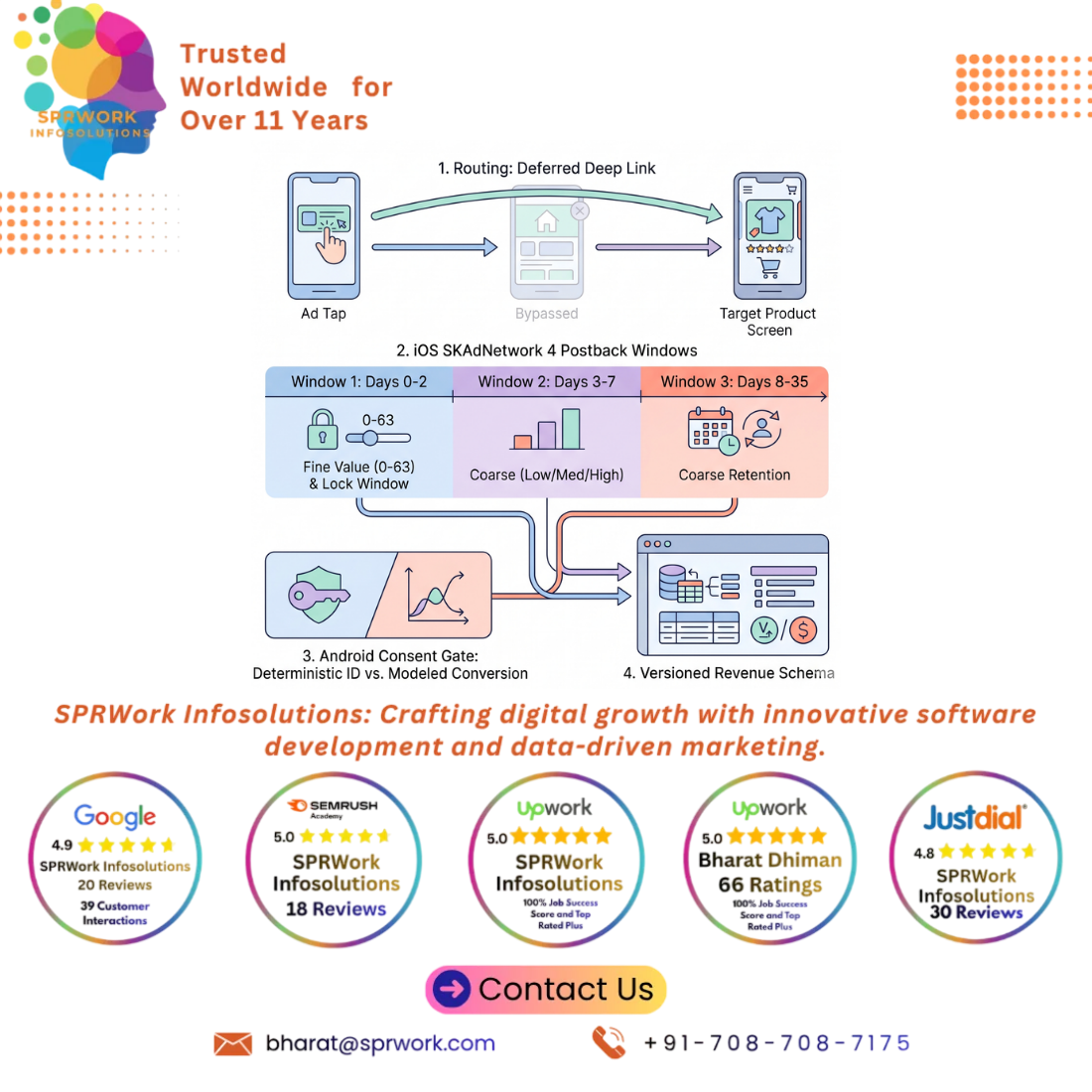
For example, a customer clicks an advertisement promoting a particular product. A deferred deep link helps direct the customer to that product after installing the application, while attribution systems help identify which campaign generated the installation.
These processes work independently but are equally important. Accurate campaign measurement does not automatically guarantee a seamless user experience, and successful deep linking does not necessarily mean the correct marketing channel receives attribution credit.
How SKAdNetwork Supports Privacy-Friendly Attribution
Apple’s SKAdNetwork allows advertising networks to measure app installation campaigns without providing advertisers with traditional user-level identifiers.
SKAdNetwork 4 introduced a measurement framework that can provide up to three postbacks for an installation across different measurement windows. The first window covers days 0–2 and can include a fine conversion value ranging from 0 to 63. The second and third windows cover days 3–7 and days 8–35, respectively, and provide coarse conversion values such as low, medium, or high.
These postbacks provide campaign performance signals while limiting access to individual user information. Apple also applies randomized delays and privacy thresholds, meaning advertisers may receive delayed or limited attribution information depending on campaign conditions.
For businesses, this makes conversion-value planning an important part of mobile application development and marketing measurement.
Why Conversion Values Matter for Mobile Applications

Conversion values help businesses communicate meaningful post-install activity through Apple’s privacy-preserving attribution framework.
Instead of assigning values randomly, businesses should connect conversion events with important commercial milestones. These may include account registration, trial activation, subscription purchases, first transactions, or other revenue-related activities.
Fine conversion values can represent more detailed early engagement signals, while coarse conversion values provide broader information about user activity during later measurement windows.
A properly structured conversion-value system helps marketing teams understand campaign quality, compare performance trends, and identify which acquisition strategies contribute to valuable customer actions.
The Importance of Deferred Deep Links
Deferred deep linking improves the experience of users who interact with advertisements before installing an application.
Without proper implementation, users may click an advertisement, install the application, and then land on its homepage instead of the product or service they originally wanted to explore.
Deferred deep links help preserve the intended destination and direct users to relevant application content after installation.
Businesses should regularly test their deep-linking implementation across iOS and Android devices, including installation flows, application updates, and different campaign destinations. This helps ensure that advertising promises and actual application experiences remain consistent.
Why Changing Attribution Vendors Does Not Solve Measurement Problems
Switching between mobile measurement providers does not automatically improve attribution accuracy. If the underlying conversion-value structure is outdated or disconnected from business objectives, a new dashboard may simply present the same measurement limitations differently.
Businesses need to review their conversion events, attribution configurations, reporting integrations, and postback processing systems regularly.
The conversion-value mapping should evolve alongside changes in the application’s revenue model, customer journey, and marketing objectives. Without clear ownership, measurement frameworks can gradually become disconnected from actual business performance.
Building a Reliable Mobile Attribution Strategy
An effective mobile measurement strategy requires coordination between application development, marketing operations, analytics, and data governance.
Businesses should begin by mapping conversion values to meaningful revenue milestones rather than assigning them to every available application event. Deferred deep links should be tested to confirm that users reach their intended destinations after installation.
Android advertising ID usage should follow applicable platform requirements and user consent choices. Teams should also establish a consistent process for handling attribution postbacks and reconciling modelled conversion data with reported campaign results.
Finally, businesses should document conversion-value versions, establish data retention policies, and clearly communicate the limitations of privacy-preserving attribution when reporting campaign performance.
How SPRWork Infosolutions Helps Businesses Build Smarter Mobile Solutions
At SPRWork Infosolutions, we understand that successful mobile applications require more than attractive interfaces and functional features. They need reliable analytics, optimized user journeys, and measurement systems aligned with business objectives.
Our engineering team develops iOS and Android applications using technologies such as Flutter and React Native, integrating deferred deep linking, conversion tracking, and attribution workflows into the application architecture.
We also help businesses structure conversion events, coordinate postback integrations, and improve their mobile measurement processes using our in-house AI capabilities and engineering expertise.
Our approach begins with understanding a specific application funnel, reviewing its existing activation and revenue metrics, and identifying opportunities to improve measurement and user experience.
Make Every Mobile Conversion More Meaningful
The future of mobile attribution is increasingly privacy-focused. As traditional device identifiers become less central to measurement, businesses must develop smarter ways to understand campaign performance and user behaviour.
SKAdNetwork conversion values and deferred deep links play complementary roles in this transition. One helps measure advertising outcomes, while the other improves the journey from advertisement interaction to meaningful application engagement.
Businesses that invest in accurate conversion mapping, reliable deep linking, and consistent measurement practices will be better prepared for the evolving mobile ecosystem.
Build smarter mobile experiences with SPRWork Infosolutions.
Schedule a meeting with our team
Frequently Asked Questions (FAQs)
1. What is mobile attribution?
Mobile attribution is the process of identifying which advertising campaign, marketing channel, or promotional activity contributed to an application installation or conversion.
2. What is SKAdNetwork?
SKAdNetwork is Apple’s privacy-preserving attribution framework that allows advertising networks to measure app installation campaigns without exposing traditional user-level identifiers to advertisers.
3. What are SKAdNetwork conversion values?
Conversion values are measurement signals that communicate selected post-install application activities. SKAdNetwork 4 supports fine conversion values from 0 to 63 and coarse values classified as low, medium, or high.
4. What is a deferred deep link?
A deferred deep link directs users to specific application content after they click an advertisement and install the application. It helps maintain continuity between the advertising experience and the app experience.
5. How are attribution and deep linking different?
Attribution identifies which campaign receives credit for an installation or conversion, whereas deep linking directs users to a particular screen or destination inside an application.
6. Does SKAdNetwork provide real-time attribution data?
No. SKAdNetwork postbacks can be delayed by randomized timers and privacy mechanisms. Consequently, advertisers should account for reporting delays when evaluating campaign performance.
7. Why should businesses regularly update their conversion-value mapping?
Conversion-value mappings should reflect current business objectives, revenue milestones, and user engagement patterns. Regular reviews help prevent outdated measurement configurations from producing misleading performance insights.
8. How can SPRWork Infosolutions help with mobile attribution?
SPRWork Infosolutions develops iOS and Android applications with integrated conversion tracking, deferred deep linking, and attribution workflows to help businesses improve mobile measurement and application performance.
 Previous Post